
Foreign exchange reserves declined by $339 million to $143.096 billion for the week ended October 21 from $143.435 billion in the previous week, according to the weekly supplement released by the RBI.

The foreign currency assets rose by $75 million to $291.39 billion
China's foreign exchange reserves look set to create a new record at $1 trillion at the end of this month or early November, posing new problems how to best manage it, economists said.

India's foreign exchange reserves declined $867 million to $593.04 billion in the week ended September 15, the Reserve Bank said on Friday. In the previous reporting week, the overall reserves dropped $4.99 billion to $593.90 billion. In October 2021, the country's reserves had touched an all-time high of $645 billion.
Foreign currency reserves declined $1.055 billion to $144.222 billion for the week ended September 16, 2005

Foreign currency assets, a key component rose $1.6 bn to $304.9 bn.
Foreign exchange reserves of eight Asian countries have depleted by a record $36 billion in August alone, as foreign investors pulled out money and central banks were seen using the reserves to prop up falling local currencies.
Foreign currency assets were down $1.516 billion to $131.426 billion. While gold reserves increased $77 million to $4.453 billion, SDRs were unchanged at $4 million.

India's forex reserves rose for the fifth consecutive week, adding $4.41 billion to $295.71 billion in the week ended December 6 on account of a rise in foreign currency assets, the Reserve Bank said.

The rise in reserves was $2.12 billion.

In the biggest weekly increase in over a year, India's forex reserves swelled by $6.56 billion to reach $531.08 billion for the week ended October 28, RBI data showed on Friday. The overall reserves, which have been on a declining spree for many months now, had dropped by $3.85 billion to $524.52 billion in the previous reporting week. The $6.5 billion jump in the reporting week is the highest since September 2021.
India's foreign exchange reserves dropped $325 million to $560.942 billion as of February 24, making it the fourth consecutive week of decline in the kitty, the Reserve Bank of India said on Friday. In the previous reporting week, the overall reserves had declined $5.68 billion to $561.267 billion. In October 2021, the forex kitty reached an all-time high of $645 billion.

Dropping for the second straight week, India's foreign exchange reserves plummeted by a hefty $3.20 billion at $284.65 billion on a heavy decline in the currency assets, the Reserve Bank said.

In response to the panic triggered by Trump's trade policies, the RBI net sold approximately $43 billion in the second half of FY25 to curb volatility, as the rupee plunged to a low of 87.95 per dollar in February this year.

The rupee has depreciated 9.7 per cent against the US dollar over a year and with the RBI stemming the rupee's weakness through dollar sales, its reserves have dropped to their lowest levels since October, 2020. The fall in reserves has widespread implications.

After a robust 2023, foreign investors significantly scaled back their investments in Indian equities in 2024, with net inflows amounting to over Rs 5,000 crore, as elevated domestic valuations, coupled with geopolitical uncertainties prompted investors to adopt a more cautious stance. Looking ahead to 2025, FPI flows into Indian equities could see a recovery, supported by a cyclical upswing in corporate earnings, particularly in domestic-oriented sectors like capital goods, manufacturing, and infrastructure, Vinit Bolinjkar, head of research, Ventura Securities, said.

The Indian government has expressed its disagreement with the IMF staff's 'baseline' assumption that the 50 per cent US tariffs on its goods exports 'would remain in place indefinitely', based on which the staff pegged the country's GDP growth at 6.6 per cent this year, and pared its 2026-27 projection by 20 basis points to 6.2 per cent.
India's forex kitty rose by $12.80 billion to $572.80 billion in the week ended March 17, the Reserve Bank said on Friday. In the previous reporting week, the reserves had dropped by $2.39 billion to a three-month low of $560.00 billion. It can be noted that in October 2021, the country's forex kitty had reached an all-time high of $645 billion.

'If it doesn't, it will continue with measures to infuse liquidity, signalling a new cycle,' predicts Tamal Bandyopadhyay.

The Budget should undertake further reductions in import tariffs and seriously consider an announcement of India's intention to join one or both of the two Asian mega-regional free trade agreements, suggests Shankar Acharya, former chief economic adviser to the Government of India.

Escalating trade tensions amid a tariff war after Donald Trump took over as President of the United States (US) could adversely impact global growth and fuel inflation, an article on the "State of the Economy" in the Reserve Bank of India (RBI) monthly bulletin said.
Forex inflows may slow down and banks may be deprived of cheap funds if the government accepts Reserve Bank of India's suggestion to tax non-resident Indian deposits, bankers warned on Wednesday.
The rupee plunged 58 paise to close at an all-time low of 81.67 (provisional) against the US dollar on Monday as the strengthening of the American currency overseas and risk-averse sentiment among investors weighed on the local unit. Moreover, escalation of geopolitical risks due to conflict in Ukraine, a negative trend in domestic equities and significant foreign fund outflows sapped investor appetite, forex traders said. At the interbank foreign exchange market, the local currency opened at 81.47, then fell further to close at an all-time low of 81.67 against the American currency, registering a decline of 58 paise over its previous close.

India's foreign exchange reserves rose by $2.8 billion to $343.2 billion

The RBI is still a small player in international gold buying among central banks. But in terms of total gold bought in 2019, it is the sixth largest buyer with 25.2 tonnes purchases in the first 10 months of 2019.

The rupee depreciated 40 paise to an all-time low of 81.93 against the US dollar in early trade on Wednesday as the strengthening of the American currency and risk-averse sentiment among investors weighed on the local unit. Moreover, a negative trend in domestic equities and significant foreign fund outflows sapped investor appetite, forex traders said. At the interbank foreign exchange, the rupee opened at 81.90 against the greenback, then fell to 81.93, registering a fall of 40 paise over its previous closing.
Continuing its downward trend for the fifth consecutive week, the foreign exchange reserves plunged $2.754 billion to $311.427 billion in the week to October 3, led by a major fall in non-US currency assets, according to data released by the RBI.

The rupee appreciated 7 paise to 79.74 against the US dollar in early trade on Thursday as a positive trend in domestic equities supported the local unit. However, a strong American currency overseas and forex outflows restricted the rupee's gain, dealers said. At the interbank foreign exchange, the rupee opened at 79.72 against the American dollar, then went lower to trade at 79.74 against the greenback in early deals, registering a gain of 7 paise over the last close.

Bangladesh is in turmoil, which is not good news for India, which shares a porous 4000 km border with it. There is a danger of fundamentalism growing there, and India has to move in to reset its ties with the new dispensation before China and Pakistan make capital out of it, alerts Ramesh Menon.

Foreign portfolio investors (FPI) have pulled out $3.5 billion from India's equity markets so far this month. The selling comes on the back of election-induced volatility and the rotation of flows from India to China, where stocks are available at half the valuations. If the selling pressure remains at the current level, this will be the highest FPI pullout since January 2023.

HDFC Bank was the top loser in the Sensex pack, shedding over 2 per cent, followed by Kotak Bank, Bajaj Finserv, Maruti, Titan, SBI, HUL, HDFC and Tata Steel. On the other hand, Bharti Airtel, M&M, NTPC, Tech Mahindra, Sun Pharma and PowerGrid were among the gainers.

Email alarm made government close arbitrage window

Exchange-traded currency derivatives volumes are likely to drop in view of new Reserve Bank of India (RBI) rules, casting a cloud over further participation of retail investors and proprietary traders. There are concerns that existing positions without any underlying exposure will need to be liquidated. Also, weighed down by dollar demand from local oil companies and weakness in its Asian peers, the rupee on Wednesday (April 3) ended at a new closing low of 83.44 versus the US currency.

'She delivers on promises, especially on security issues which is a core concern for India.'

Kotak Bank was the top loser in the Sensex pack, falling around 3 per cent, followed by Axis Bank, Sun Pharma, HDFC Bank, Bajaj Finance and Asian Paints. On the other hand, ONGC, PowerGrid and IndusInd Bank were the gainers.
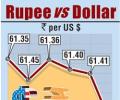
The rupee had ended almost flat at 61.41 against the Greenback in the previous session on Wednesday on alternate bouts of buying and selling.

A weak US dollar in overseas markets was the main reason for the rupee's rise even as losses in domestic stocks and some fag-end dollar demand from importers prevented further gains
Planning Commission on Thursday said a desicion was expected shortlyon using foreign exchange reserves for infrastructure projects.
Bucking a strong trend in share market, the Indian rupee on Monday gave up all its initial gains and slipped 18 paise to close at 61.94 against the Greenback on rising dollar demand from importers.
The EU is likely to intensify sanctions if the situation remains tense.
